

the cold room
At first, everything looks luxurious.
Perhaps a new butcher shop. One of those radically minimalist boutiques that have consciously rejected the idyllic image of a weekly market and the romantic notions of a butcher's shop. Stainless steel instead of wood, glass instead of tiles, cold light instead of warm promises. A place for people who want to know exactly what they're buying – and are prepared to pay for it.
The Cold Room is located on the ground floor of a former department store from the 1970s, on the edge of The Hague's city center. Concrete, long ribbon windows, almost invisible from the outside. Only one room is brightly lit. Inside, everything appears precise, controlled, high-quality. As if someone had transferred the aesthetics of a high-end fashion store to meat.
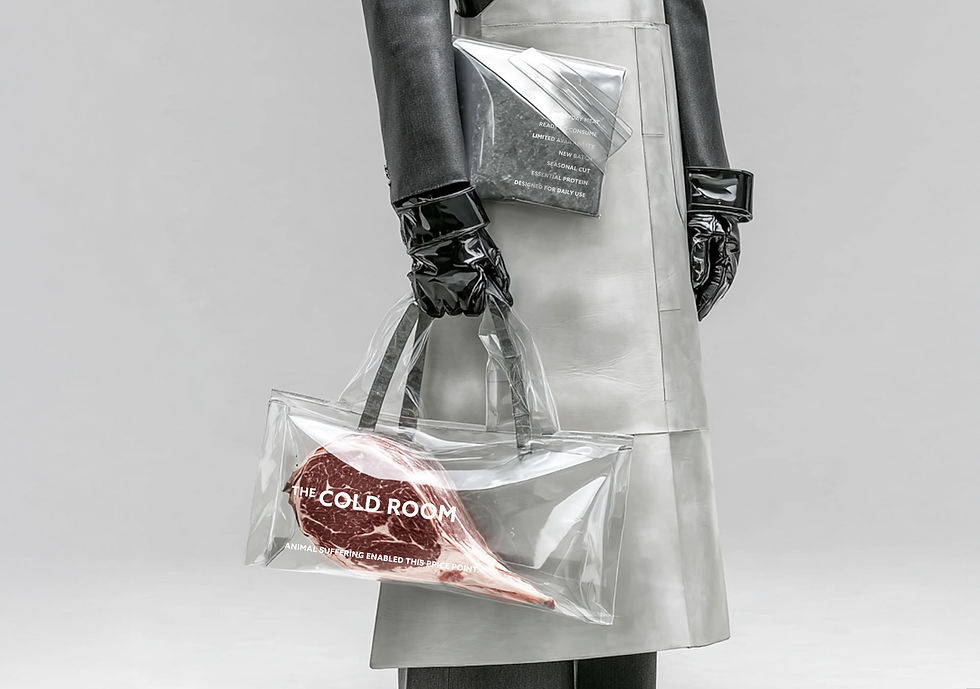
Behind large glass doors, sides of beef hang from poles, arranged like coats. Vacuum-packed cuts, framed in silver, transparent, flawless, lie on shelves. On the counter: pre-packaged goods, neatly presented, labeled like luxury products. The salespeople wear shirts and ties, white patent leather aprons, and black rubber gloves. Their movements are calm, professional. Little is said. Everything points to one thing: meat is sold here. Expensive meat. Consciously sourced meat. Luxury meat.
Only later do you realize that something is wrong.

Because nothing here is real. Not a single piece of meat comes from an animal. No side of beef, no fillet, no cut is real. The Cold Room is not a slaughterhouse. It's not a shop either. It's an installation.
And that is precisely where the real shock lies.
Because The Cold Room doesn't show what meat looks like. It shows how we've learned to look at it. As a product. As an object. As a commodity whose origin, resource consumption, and consequences lie somewhere outside our field of vision.
The packaging contains stark information. No stories, no pictures, no promises. Instead, numbers and terms, presented like care instructions on a garment: Water consumption per kilogram. Origin of animal feed. Land use. Waste disposal. Environmental impact not offset.
Those who read them begin to calculate.
Would meat truly be produced under conditions that do not harm the environment, soil, and water? Would animals be raised in a way that does not come at the expense of the general public? Would wastewater, emissions, feed costs, and infrastructure be honestly factored into the price?
Then meat wouldn't be an everyday product. It would be a luxury.
Several hundred euros per kilogram. At least.
But the exact opposite is true. Meat is cheap because a large part of its costs is outsourced: to polluted soils, contaminated waters, public sewage treatment plants, and global supply chains.
We pay the price – just not at the checkout.
The Cold Room reverses this logic. Not by moralizing, but by aestheticizing. It presents meat the way fast fashion presents clothing: perfectly staged, always available, desirable. Responsibility disappears behind surfaces. You buy—or want to buy—because it looks good. Not because you know what's behind it.
The fact that all of this is just a backdrop amplifies the effect. The installation works too well. Too many visitors initially mistake it for the real thing. And that's precisely the point.
Behind the project is an artist couple who deliberately avoid explanations. For them, The Cold Room is not a commentary, but a mirror. It shows how readily we mistake luxury aesthetics for quality – and how easily even the most difficult topics can be neutralized if they are packaged well enough.
In the end, you leave the room with a strange feeling. Not because you saw meat, but because you realized how normal everything felt.
Perhaps that is the real insight of The Cold Room: that meat is not a luxury only because we have chosen not to treat it as such.
And that we are very good at not looking – as long as it looks nice enough.

DWHH.art is the personal art project of Daniel Weiss – a collaboration between humans and AI. All stories and images are fictional – created with artificial intelligence, told with human imagination. For all those who believe that beauty is allowed to think.


Comments