

Kabuki Frame

Updated: Nov 16, 2025
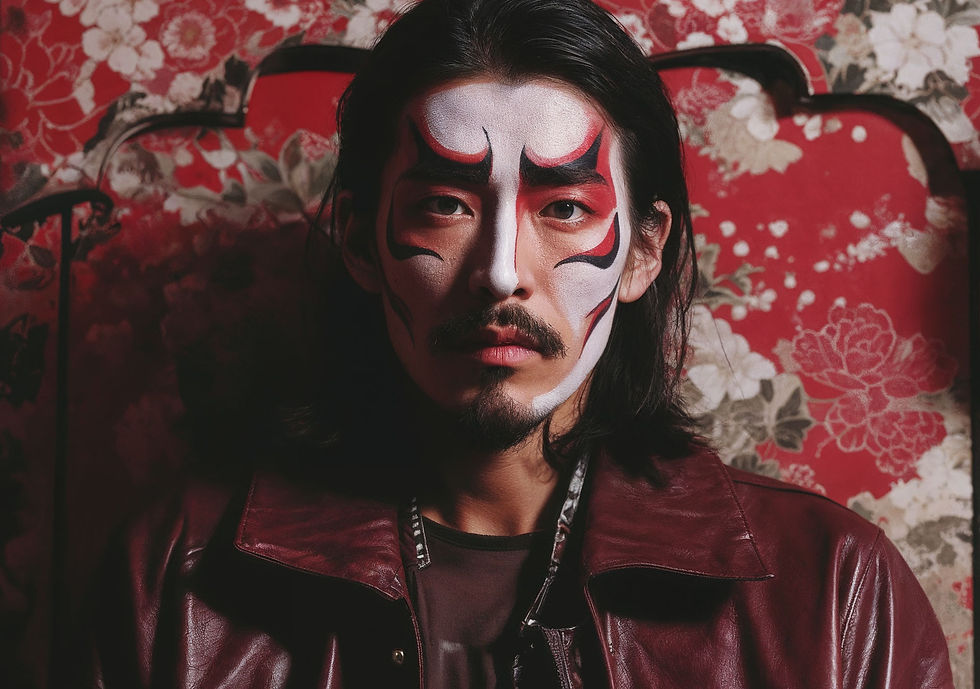
In the underground spaces of Tokyo, he embodies a movement that dissolves the boundaries between theatre, fashion, and identity a return of the mask in a time that had forgotten how much it needed one.
I hadn’t expected to see anything that would silence me that night. Tokyo, Friday, 10:47 p.m. An address whispered to me in a café in Daikanyama.“Just go down into the garage,” she said. “If you think you’re in the wrong place, you’re in the right one.”
The air smelled of concrete and perfume. Tape marked narrow paths on the floor. And then people. Dozens, maybe hundreds. No music. No club. Just light, suddenly coming on. And in that instant I realised: this wasn’t a rave. It was a performance.
A young man stood in the centre, still, barefoot, his face painted in white, black and deep red. The make-up recalled Kabuki Japan’s centuries-old theatre form once performed exclusively by men, who played both genders, mastering gestures so precise that a single flicker could express pain. But this was different. No costume. No orchestra. No golden curtain. Only light, bodies, and silence.
He moved slowly, almost defiantly, with an elegance that refused to prove itself. Later, I learned his name: Ren Sato dancer, performer, model, depending on whom you ask. For many, he is the face of a new movement that is pulling Kabuki out of its theatres and into the present.
“We’re not performing tradition,” he told me later, near a van where costumes and lighting gear were being packed away.“ We’re performing ourselves. Kabuki was never old it just got too serious.”
The Collective around Ren designers, musicians, former actors call themselves Kabuki Frame. They perform where no one expects them: in parking garages, abandoned department stores, temporary galleries.One post, one location, one light. Sometimes ten minutes, sometimes until dawn.
I saw Ren again later that night. He was sitting on a crate, a script resting on his knees, make-up half erased, a paper cup of coffee steaming beside him. He looked tired but awake in another sense. Maybe, I thought, that’s the real art of this new Kabuki: not to play someone, but to stay.
And when I walked back up the ramp, I realised something had begun. Not a trend, not a hype: a movement. Quiet. Precise. Beautiful. So old it feels new again.
DWHH.art is the personal art project of Daniel Weiss – a collaboration between human and AI, idea and image. All works are digital fictions, created through artificial intelligence and told through human imagination. For those who believe that beauty can think.



Comments