

Nikos Salda in Paris
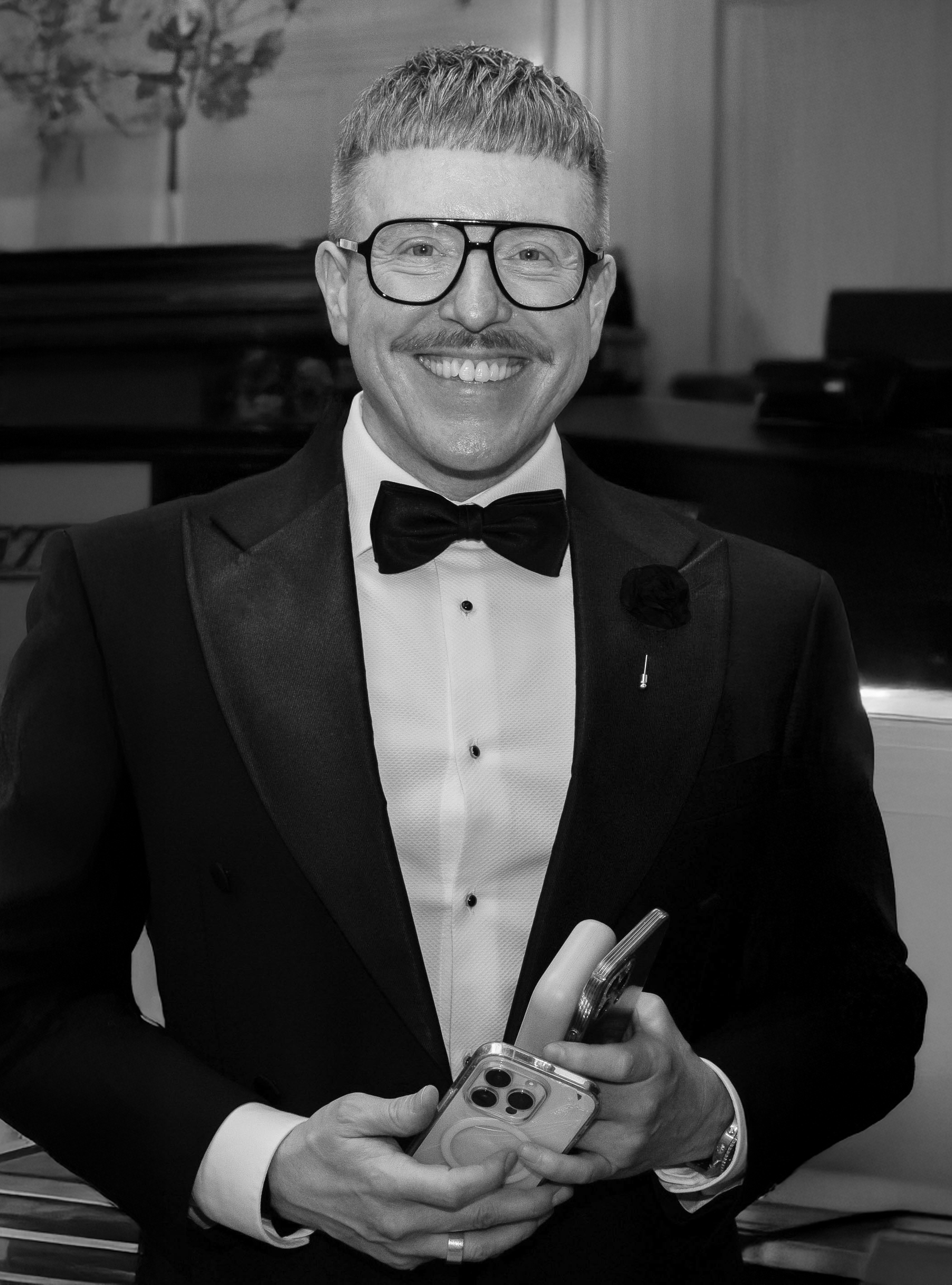

"At some point I realized that we could actually build it."
Nikos Salda talks about his floating cube on the Seine, the limits of what is technically feasible, and the luxury of not having to diminish an idea.
When we last met in Athens, a massive net of black ropes hung over the Acropolis. Since then, Nikos Salda has had to solve a very different problem: how to make a six-story-high steel cube float in the middle of the Seine while tons of structures move inside it? We meet in Paris, not far from his new installation, ALLWAYS OPEN. Nikos seems relaxed. Perhaps that's because the cube is now actually floating.
DW: Nikos, when I saw the first pictures, I thought you had finally lost your mind.
NS: That's what some people said. Especially the engineers.
DW: A six-story-high steel cube on a river is already a pretty absurd idea. But you also wanted the walls inside to move.
NS: That was indeed the more difficult part. Floating a large object is, first and foremost, a technical problem. But when heavy elements within this structure are constantly shifting, the load distribution changes. And at the same time, people are moving around inside it. So you have to develop a system that compensates for these changes without the visitors noticing anything.
DW: That sounds like a rather expensive undertaking.
NS: That was it. Very much so. A few years ago, I couldn't even have seriously proposed such a project. It was only through the success of our recent work that I had the opportunity to sit down with the right people. And even then, there were plenty of moments when we thought it wouldn't work.
DW: What was the moment when this crazy idea became a real project?
NS: When the engineers stopped explaining to me why it couldn't be done and started discussing how it could be done. That was a pretty good day.
DW: And you didn't consider simply placing the cube on land at any point?
NS: Of course. But then it would have been a different work. The river isn't a backdrop. Visitors are meant to get from one bank to the other, and the installation itself is situated in between. It's literally a transition. Besides, I like the idea that a building dealing with boundaries doesn't itself have solid ground beneath its feet.
DW: That's a pretty nice picture. But probably not a sentence that would reassure a structural engineer.
NS: No. We had other discussions about that.
We walk a short distance along the shore. From here, the cube seems almost unreal. A massive red grid that appears to float above the water. Only after looking for a while do you realize that something is actually moving inside. Walls slowly slide to the side, passageways open, others disappear. The architecture changes as visitors try to find their way through it.
DW: You once said that you like architecture because it forces people to engage with it. With ALLWAYS OPEN, it now seems to be fighting back against its visitors.
NS: She doesn't do that at all. She just doesn't treat everyone the same.
DW: Which probably amounts to the same thing for those affected.
NS: Maybe. But that was important to me. I didn't want to build a labyrinth where everyone has the same chances and the most skillful wins. That would be a game. In ALLWAYS OPEN, chance determines which opportunities you get. You can be as clever, experienced, or athletic as you like. If your pass sends you to the sixth floor, then you go to the sixth floor.
DW: While I stroll leisurely downstairs with a German passport.
NS: If you drew it, maybe you'll get another one. And that's exactly what interests me. We speak so casually of our freedoms, as if they were a personal achievement. Yet most of us didn't do much to earn the right to be born where we were born.
DW: So you're essentially letting your visitors draw lots for their lives again.
NS: For twenty minutes, yes. After that, they get their old reality back. That is perhaps the greatest luxury of this installation.
DW: How are people reacting to this?
NS: It varies greatly. Some take it in stride and try to get through as quickly as possible. Others get annoyed by the detours. It becomes interesting when they realize that the rules are non-negotiable. They can complain, but that won't change their course. And then there are those who have taken an easy route and still stop because they want to see how the others manage.
DW: Are they helping them?
NS: Sometimes. But helping others isn't so easy in this system. You can explain to someone where the nearest staircase is. But you can't let them use your own passageway. I find that almost more interesting than the different paths.
DW: You built the 13th star because Europe is something unfinished for you. Is ALLWAYS OPEN a continuation of that?
NS: Yes, but perhaps a more mature one. With the star, I was interested in an idea, a symbol that makes visible that Europe is not yet finished. With ALLWAYS OPEN, I'm less interested in the symbol than in the experience. I wanted to know if political differences can be translated in such a way that people not only understand them, but also feel them viscerally for a moment.
DW: Your father would probably have chosen a more diplomatic approach.
NS: Absolutely. He would probably have spoken with all parties involved first, established a committee, and eventually published a joint statement.
DW: And you place a red steel cube in the river for them.
NS: We both have our methods.
He laughs. His father, who worked as a diplomat, keeps coming up in our conversations. When we met in Athens some time ago, Nikos told me that he only understood how much his father's work had influenced him after his death. At the time, he spoke of wanting to build visible bridges where his father had created invisible ones. In Paris, this idea has now become a rather literal construction.
DW: Looking at your development, I wonder if you even accept limits anymore. Your projects are getting bigger, more elaborate, and obviously increasingly expensive. Is there a point where you yourself say that something is too much?
NS: Of course. I've actually become more cautious now. That might sound strange when you're standing in front of this building, but with size comes responsibility. Before, I could put up scaffolding, realize it wasn't working, and change it the next day. Today, hundreds of people work on projects like this. You can't just wake up one morning and decide the cube should be round after all.
DW: That's a shame.
NS: Yes, sometimes. But I've also learned that a good idea doesn't become better by pushing it through against all odds. You have to listen to the right people. Especially those who tell you that something won't work.
DW: That sounds surprisingly reasonable.
NS: I know. It worries me a little myself.
DW: And yet you insisted that the walls move.
NS: Because that's the core of the work. Boundaries are not immutable. They arise through decisions, they shift, they are opened and closed again. A static labyrinth couldn't have told this story. It would only have shown that some paths are longer than others. But I also wanted to make visible that the rules themselves are in flux.
DW: So there is no single right way.
NS: Exactly. And sometimes things change even though you haven't done anything yourself. A door that was open yesterday is closed today. Or vice versa. We experience this constantly in Europe. Just usually not so vividly.
We stop in front of the installation. Above the lower level, the large disco ball glitters, visible even from the opposite bank. Below it lies the PLAZA, an almost empty space containing only the bust of Princess Marie-Astrid.
DW: Now I have to ask you about the Plaza. You build this incredible building for a fortune, let people walk through six floors, and in the end there's just a bust in an empty square. I think they could have put a bit more effort into it.
NS: (laughs) I hear that surprisingly often. Apparently, an empty seat is now the greatest provocation imaginable.
DW: But you have to admit that the disco ball raises pretty high expectations.
NS: Of course. It's a temptation. You see something glittering and imagine that there must be something special there. Maybe a festival, maybe a community, maybe simply a place where life is a little better. But what exactly you expect is up to you.
DW: And then there's nothing.
NS: There's a lot of space, Daniel. It's not the same thing.
DW: That sounds very much like an artist's perspective.
NS: Maybe. But consider how rarely we enter a space today that isn't already completely organized. Everywhere there are rules, offers, expectations, programs. At the PLAZA, there's none of that, at least initially. You can perceive that as a disappointment or as an opportunity. I find both reactions interesting.
DW: So you don't want to commit to whether Europe's promise will ultimately be fulfilled.
NS: How could I? Europe means something different to everyone. For some it's home, for others a place of longing, for still others a rather complicated bureaucracy. I didn't want to create a place where a ready-made answer awaits.
DW: And Princess Marie-Astrid has to watch all of this.
NS: At least she has the best seat.
DW: What increasingly interests me about your work is the question of how much you actually trust people. You don't give them easy answers, but you demand quite a lot from them.
NS: I think we often underestimate people. Not everyone needs an explanatory panel to understand something. And not everyone has to leave an exhibition with the same insight. If someone leaves ALLWAYS OPEN and seriously wonders for the first time why their own passport opens up so many possibilities for them, that's good. If someone leaves with completely different thoughts, that's just as fine.
DW: And what if someone only finds the architecture magnificent?
NS: Then I'm happy too, of course. After all, we've worked on it long enough.
A small group has gathered on the opposite bank, photographing the cube. Nikos watches them for a while. It's hard to tell whether he's more interested in how people are reacting to his work, or whether he still can't quite believe that this structure is actually floating on the Seine.
DW: When we first met, you said you wanted to build bridges that were visible. Now you've built one that some people have to cross with considerable difficulty. Isn't that a contradiction?
NS: Yes. A rather large one, in fact.
DW: And that doesn't bother you?
NS: On the contrary. I think that's the most interesting thing about this work. A bridge is usually a promise that you can get from one side to the other. But this promise says nothing about the conditions under which that happens. Perhaps this time I haven't built a bridge, but rather explored the question of what a bridge should actually accomplish.
DW: You're becoming philosophical.
NS: We've been sitting in front of a floating steel cube for an hour, talking about Europe. What did you expect?
DW: At least one last espresso.
NS: You'll get it. But this time you'll pay.
DW: Why me?
NS: Because you got here just as easily with your Austrian passport as I did with my Greek one. We both know pretty well which side of the birth lottery we're on.
DW: And that's why I have to pay for the coffee now?
NS: No, Daniel. Because you invited me.
A fictional conversation between Daniel Weiss and Nikos Salda. Part of the AI art and storytelling project DWHH.art.
DWHH.art is the personal art project of Daniel Weiss – a collaboration between humans and AI. All stories and images are fictional – created with artificial intelligence, told with human imagination. For all those who believe that beauty is allowed to think.


Comments